




Rugby

Share
Published 15:08 23 May 2019 BST
Updated 15:21 23 May 2019 BST
Explore more on these topics:
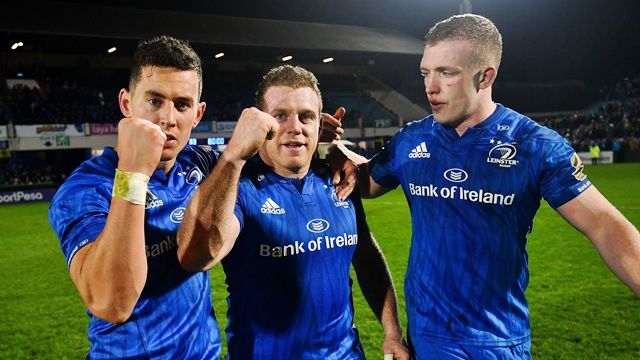 Interprovincial transfers - while they existed before with the likes of Sean Cronin and Niall Ronan - were more of an oddity prior to Nucifora's arrival but they have become much more prevalent in the years since he has joined the IRFU with Ireland internationals Joey Carbery, Jordi Murphy, Andrew Conway, John Cooney, Robbie Henshaw and more all availing of beneficial transfers with British & Irish Lion prop Jack McGrath and scrum-half Nick McCarthy both leaving Leinster to join Ulster and Munster respectively next season.
The freedom of movement has ultimately benefited the Irish provinces from a success point of view as it has placed less of a strain on the academy system.
Munster only had seven members of their starting XV against Leinster last weekend that graduated through the club's academy but they nevertheless advanced to both the Champions Cup and PRO14 semi-finals for the second consecutive season.
Meanwhile Ulster had nine academy graduates in their starting XV that played Glasgow last weekend, and although they may have been thrashed at Scotstoun, they were still apart of a side that was playing semi-final rugby.
Carbery, Murphy and Cooney will be the poster boys of interprovincial transfers but below the surface there are the likes of Cian Kelleher leaving Leinster for Connacht and then returning to Leinster again. There's Stephen Fitzgerald joining Connacht on loan. Bill Johnston leaving Munster to join Ulster. Sam Arnold leaving Ulster to join Munster.
Nucifora has been able to foster an environment where it is no longer as much about who you're playing for as much as it has become about how much you are playing and where do you rank among the competition in your position.
He's created an environment where players like John Cooney can go from sitting on the bench at Connacht to coming off the bench for Ireland within the space of one season, or where Joey Carbery can go from being the third-choice fly-half at Leinster to the Champions Cup top points scorer of the Pool stages with Munster just one season later.
Cooney's position of scrum-half, for example, has three players across three provinces essentially battling for the role of deputy scrum-half with Ireland while the second-row is a constant guess with five to six players fighting for two spots at any one time.
Interprovincial transfers - while they existed before with the likes of Sean Cronin and Niall Ronan - were more of an oddity prior to Nucifora's arrival but they have become much more prevalent in the years since he has joined the IRFU with Ireland internationals Joey Carbery, Jordi Murphy, Andrew Conway, John Cooney, Robbie Henshaw and more all availing of beneficial transfers with British & Irish Lion prop Jack McGrath and scrum-half Nick McCarthy both leaving Leinster to join Ulster and Munster respectively next season.
The freedom of movement has ultimately benefited the Irish provinces from a success point of view as it has placed less of a strain on the academy system.
Munster only had seven members of their starting XV against Leinster last weekend that graduated through the club's academy but they nevertheless advanced to both the Champions Cup and PRO14 semi-finals for the second consecutive season.
Meanwhile Ulster had nine academy graduates in their starting XV that played Glasgow last weekend, and although they may have been thrashed at Scotstoun, they were still apart of a side that was playing semi-final rugby.
Carbery, Murphy and Cooney will be the poster boys of interprovincial transfers but below the surface there are the likes of Cian Kelleher leaving Leinster for Connacht and then returning to Leinster again. There's Stephen Fitzgerald joining Connacht on loan. Bill Johnston leaving Munster to join Ulster. Sam Arnold leaving Ulster to join Munster.
Nucifora has been able to foster an environment where it is no longer as much about who you're playing for as much as it has become about how much you are playing and where do you rank among the competition in your position.
He's created an environment where players like John Cooney can go from sitting on the bench at Connacht to coming off the bench for Ireland within the space of one season, or where Joey Carbery can go from being the third-choice fly-half at Leinster to the Champions Cup top points scorer of the Pool stages with Munster just one season later.
Cooney's position of scrum-half, for example, has three players across three provinces essentially battling for the role of deputy scrum-half with Ireland while the second-row is a constant guess with five to six players fighting for two spots at any one time.
 The competition has increased value across the positions as Joe Schmidt and Nucifora look to avoid the pitfalls of the 2015 Rugby World Cup where their lack of depth was exposed while they also look to continue to grow a sustainable system.
“A lot of the success is down to Joe, he’s driven a lot of really good things in the Irish game, not just in the national team,” Nucifora said last year. “But part of his strength is to make sure he’s built a team that can carry those things on, carry them forward. Any good programme has to be sustainable and a lot of work we do is about that, it’s about being sustainable. “Joe will be the first one to tell you he’d be confident we’ve built something sustainable and we’ll be continuing to focus on that.”Nucifora's other big achievement in his role as Performance Director has been the rise of Irish Sevens. The IRFU did not introduce a men's rugby sevens national team program until October 2014, six months into Nucifora's appointment, and five years later they laid claim to the 2019 Hong Kong Sevens qualifier with Jordan Conroy’s 10 tries across six matches earning him Player of the Tournament honours. The win in Hong Kong also grants the IRFU core nation status which allows the union to send teams to compete at all series events, while the women's team also claimed fourth spot at the Sydney 7s tournament after a sixth place finish at last year's World Cup. The women's XV team and their part-time coach role was an undoubted bleak point of Nucifora's reign; with the women's team failing to build on their 2013 and 2015 Six Nations' successes; but the IRFU's latest strategic plan for 2018-2023, which Nucifora helped devise, aims to count the female representation in rugby in Ireland at a minimum of 20% – including players, coaches, referees, volunteers and committees - as well as targeting consistent top three finishes and one title in the Six Nations for Ireland Women over the next five years, as well as a first-ever top-six finish at the 2021 World Cup. Director of Rugby, Sporting Directors, Performance Directors etc., have attracted some degree of scorn over the last few years for the lack of clarity around their titles at times but Nucifora is essentially Irish Rugby's big decision maker and for the most part the Australian has got an awful lot of his decisions right. The decision to extend his contract until the end of the 2021/22 season is deserved as Irish Rugby continues to try and build a sustainable model in his mould.
Rugby
Rugby
Rugby
Rugby
We’ve a few surprises in the Ireland 23 we want to see vs Argentina
A strong side! Ireland take on Argentina on November 6 (kick-off: 8.10pm), in the opener of their November Nations Championship games. Here is the 23 we would like to see take the field. Front row Ireland need momentum, not just for this series, but in general; given their underperformances over the last year. For that […]
Rugby
23h
Keith Earls takes opposite stance to O’Mahony on ex-Munster coach
Interesting… Peter O’Mahony was in the news recently over his comments on former Munster head coach Graham Rowntree [Wig]. Their relationship soured towards the end of Rowntree’s time at Munster – he left abruptly in the middle of the 2024/2025 season – with both O’Mahony, and fellow Munster icon Conor Murray, both speaking of the […]
Rugby
2 days ago
Rugby
Current Leinster star reveals his new coaching role for the province
Rugby